
Research
Research Areas
The DFG-funded interdisciplinary research training group investigates texts from Antiquity and the Middle Ages that consciously depend on their original sources and are, in this sense, "heteronomous".
This group of related text forms, which has not yet been systematically documented in context, includes commentaries, paraphrases, compendia, lexicons, chronicles, collections, retold novels, and the like. Such texts contributed significantly to the development of culture and science in Antiquity and the Middle Ages. The texts are examined across disciplines to determine how they develop their own "autonomy" through the ongoing selection and processing of their original sources on various levels – scientific, cultural, formal, and aesthetic.
The structure of the research training group arises from a network of four interconnected research areas. They encompass four groups of heteronomous texts that vary in their dependence on their original sources or pretexts.
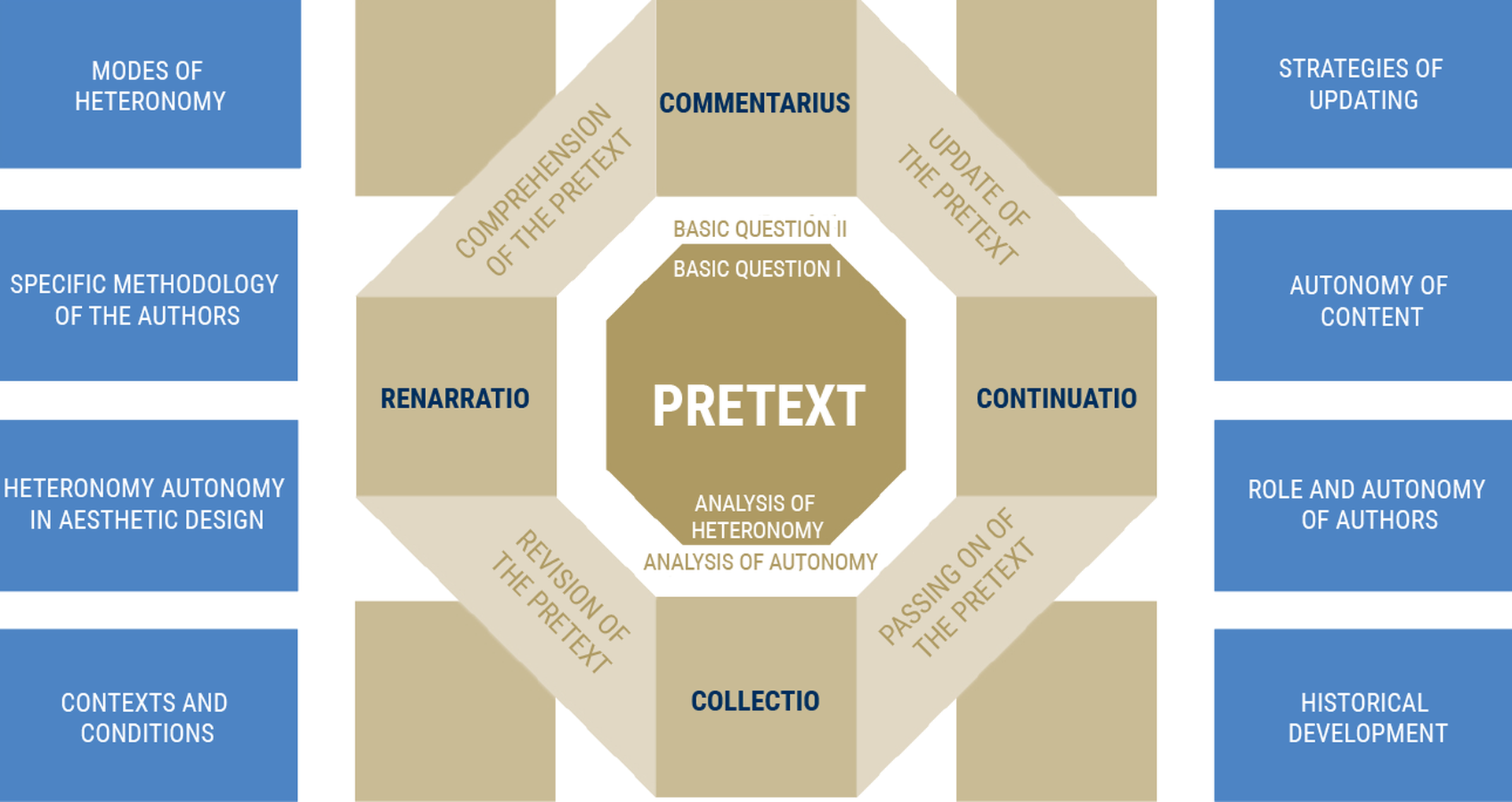

Commentarius – The Explanatory-Exegetical Field
A typical characteristic of the genre is a narrow textual orientation, which can manifest itself in various forms as conservative heteronomy. This form originated in the imperial period. It reached its full development at least with Alexander of Aphrodisias around 200 AD and continued to flourish, in scholarly commentaries, sermons, and many other forms, into the Middle Ages.
All forms of commentary literature, namely
- Commentaries of various forms, e.g., as continuous lemma commentary, as question commentary, as commentary in dialogue form, as catena commentary, as glosses and scholium, etc.
- Other commentary-like texts and text fragments, e.g., refutations that critically address a source material, explanatory passages in biblical texts (e.g., in the Epistle to the Hebrews on the Septuagint), or even sermons
- Pretexts of such commentary texts (i.e., commented texts) are
- in theology, namely the Bible (e.g., by Philo, Hippolytus, Origen, Methodius of Olympus, Ava of Göttweig, Peter Comestor, etc.) and occasionally other texts, e.g., creeds or the Sentences of Peter Lombard
- in philosophy, Aristotle, Plato, and other classical texts (e.g., Epictetus, Enchiridion, Theoprastus, Avicenna, the Liber de causis, etc.)
- in medicine, the works of Hippocrates, Galen, and later Avicenna
- in jurisprudence, works of older jurists, commented on, for example, by Domitius Ulpianus and Julius Paulus or the interpretation of Paul's Sentences in the Lex Romana Visigothorum
- in grammar, classical treatises such as Dionysius Thrax, Priscianus, etc.
- in the interpretation of literary texts, classics such as Homer and Ovid
- Compendia such as those by Isidore of Seville, commented on, for example, by Hrabanus Maurus
- Furthermore, numerous texts to be interpreted or refuted
Collectio – The Anthological-Encyclopedic Field
This field encompasses anthologies and encyclopedic literature, whose common characteristic is that, in the sense of a reconstitutive heteronomy, various excerpts, edited and organized using specific techniques, form a new text or its core. The author’s specific contribution here lies in the selection and rearrangement of the material, including its literary design, chapter organization, and, in many cases, independent prefaces. This field also includes cases in which the new text compiles marked quotations or unmarked excerpts and combines them with the author's own words to form an organic whole.
All forms of compilations, especially
- the large collections of quotations from traditional literature (Stobaeus, Anthologia Palatina, Apophtegmata patrum, etc.)
- Dictionaries and compendia created through the systematic compilation of various materials (Suda, Isidore of Seville, Peter Lombard, Celsus, Alexander of Tralles, Oreibasius, etc.)
- Collections of legal texts (Institutiones, Digestae, Decretum Gratiani, etc.)
- Collections of biographies and doxographic opinions (already in Aristotle, later in Aetius, Diogenes Laertius, etc.)
- Collections of evidence texts (Abelard, Sic et Non; Moralium dogma philosophorum, etc.)
- Compilations of questions, letters, sermons, recipes (e.g., in Gregory the Great), fables (Aesop), prologues and hypotheses on scholastic authors, etc.
- ancient and medieval Manuscripts and editions that arrange texts in a (more or less systematic way) and add paratexts (headings, outlines) (e.g. archetype of the Lucretius manuscripts; Porphyry's edition of Plotinus
Continuatio – The Continuing-Supplementing Field
Another type of preserving heteronomy is the various forms of continuation literature that exist from antiquity and the Middle Ages. Their characteristic is that the pretext remains essentially unchanged during a continuation, but is supplemented.
Continuation and completion literature of all kinds, namely:
- Continued chronicles and continuations of historical works (Rufinus's continuation of Eusebius's Church History)
- Continuations and additions to epics and novels
- Continuations of prophetic and other sacred texts (e.g., the Book of Jeremiah, the Psalms of Solomon)
- Completions and additions to scientific and literary works, e.g., the Appendix Vergiliana, completions of unfinished works by Thomas Aquinas, Duns Scotus, and others
- Additions and expansions to hagiographic literature (e.g., Martinellus)
Renarratio – The Paraphrastic-Diegetic Field
Another form of reconstitutive heteronomy is the retelling or paraphrase of another text, which we summarize under the term "renarratio". Here, the pretext is not transposed in its literal form, but is usually rendered in the text's own words.
Any retellings that alter the wording of their originals, namely:
- Paraphrases of scholarly texts (analogous to the commentaries under "Commentarius"), e.g., Caelius Aurelianus's on Soran,
- Own interpretations of the original material, such as those provided by Avicenna and Albertus Magnus for Aristotelian works
- Retellings of literary works, e.g., retold novels or biblical poems
- Free translations that use one's own words
- Compendia and epitomes that independently adapt their originals (e.g., historical breviaries such as those by Aurelius Victor, Eutrope, or Festus)